

Latest Version
1.0.9
July 01, 2026
Christophe Auclair
Education
Android
0
Free
air.com.multimaths.trigo
Report a Problem
More About Trigonométrie
Mastering Geometry: Engaging Activities and Exercises for Cycle 4 and Second Year Students
In the realm of mathematics, particularly in geometry, understanding the properties of figures is crucial for students in Cycle 4 and second year. This article delves into a structured approach to mastering geometric concepts, focusing on the essential skills of determining geometric quantities and engaging in reasoning and proof. Below, we explore a variety of activities, training exercises, and problem-solving scenarios designed to enhance students' comprehension and application of trigonometric principles.
I. Engaging Activities
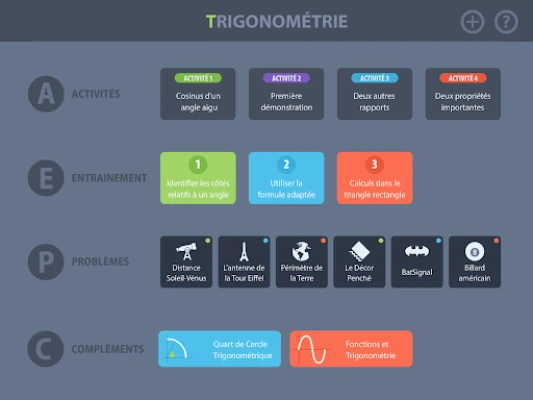
To facilitate a comprehensive understanding of trigonometry, four key activities are available:
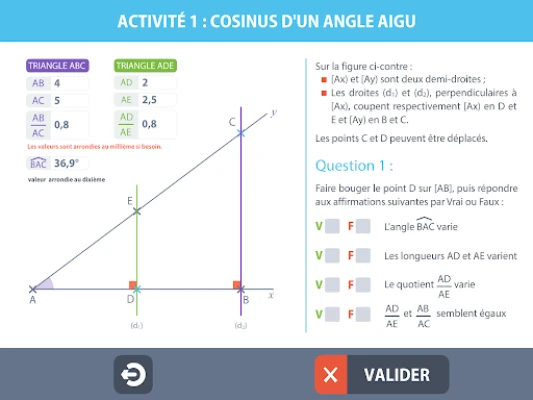
- Exploration of the Cosine Function: Students will discover the fundamental aspects of the cosine function, learning how it relates to right triangles and the unit circle.
- Guided Demonstration of the Cosine Formula: This activity provides a step-by-step approach to understanding the cosine formula, reinforcing the concept through practical examples.
- Introduction to Sine and Tangent: Students will explore the sine and tangent functions, gaining insights into their applications in various geometric contexts.
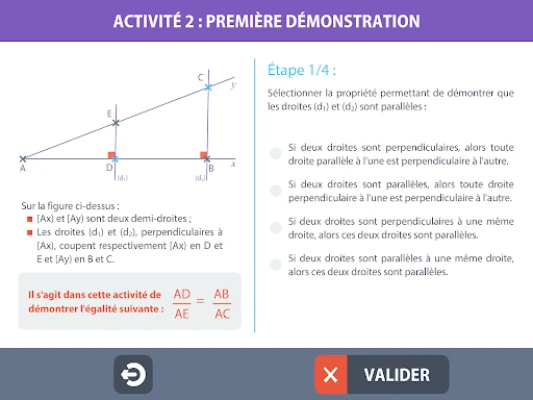
- Guided Demonstrations of Fundamental Properties: This activity focuses on the essential properties of trigonometric functions, helping students to grasp their significance in geometry.
II. Training Exercises
To solidify their understanding, students can engage in three targeted exercises:
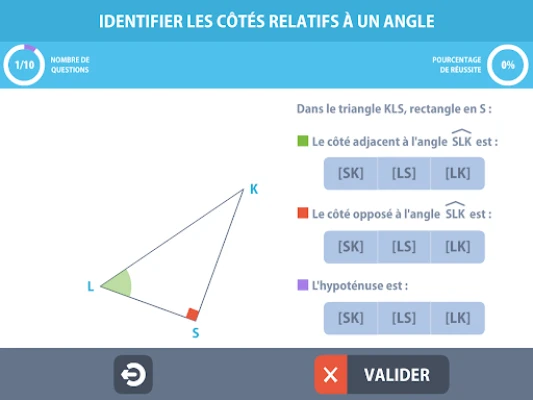
- Identifying Sides in a Right Triangle: This exercise challenges students to accurately identify the sides of a right triangle, reinforcing their understanding of triangle properties.
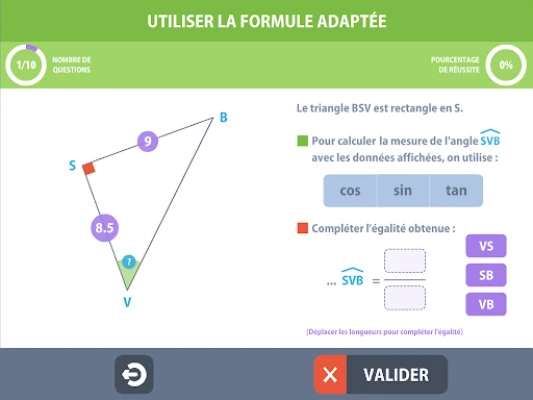
- Selecting the Appropriate Formula: Students will learn to choose the correct trigonometric formula based on the given problem, enhancing their problem-solving skills.
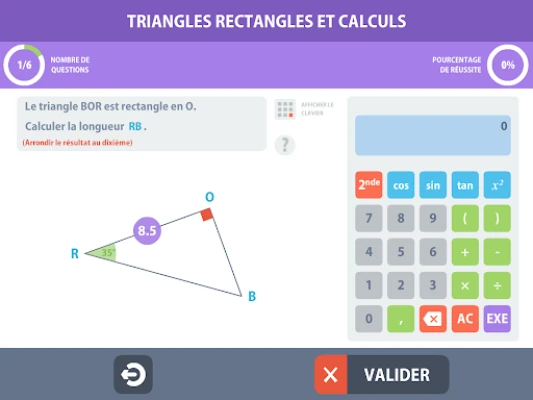
- Calculations in Right Triangles: This exercise allows students to perform calculations involving lengths and angles in right triangles, applying their knowledge in practical scenarios.
The final exercise is customizable, allowing educators to adjust the number of questions, select specific trigonometric lines, and determine whether to focus on calculating lengths or angles. At the conclusion of each exercise, students receive feedback in the form of a mastery level assessment. Success scores can be tracked using the scanScores application, providing a clear indication of progress.
III. Problem-Solving Scenarios
To further challenge students, six intriguing problems are presented:
- Distance from the Sun to Venus: A real-world application that encourages students to apply their knowledge of trigonometry to astronomical distances.
- Eiffel Tower Antenna: This problem involves calculating the height of the antenna using trigonometric principles.
- Circumference of the Earth: Students will explore the relationship between geometry and the Earth's dimensions.
- Inclined Decor (Angle): This scenario requires students to determine angles in practical design situations.
- Batsignal (Angle): A fun application of angles in a pop culture context, engaging students' interests.
- American Pool (Angle): This problem involves calculating angles in a billiards game, making learning interactive and enjoyable.
For each exercise, a calculator is available, although its use is not mandatory. The application also detects rounding errors and provides notifications, ensuring students learn from their mistakes.
IV. Additional Activities
To further enrich the learning experience, two supplementary activities are offered:
- Trigonometric Quarter Circle: This activity allows students to visualize and understand the relationships between angles and trigonometric functions.
- Trigonometry and Functions: Students will explore the connections between trigonometric functions and their applications in various mathematical contexts.
By engaging in these activities and exercises, students in Cycle 4 and second year will not only enhance their understanding of geometry and trigonometry but also develop critical thinking and problem-solving skills that are essential for their academic journey. This structured approach ensures that learners are well-equipped to tackle complex geometric concepts with confidence.
Rate the App
User Reviews














Popular Apps










Editor's Choice