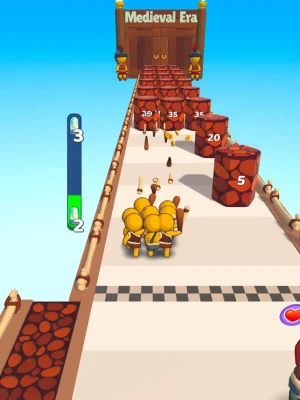
Latest Version
1.2.5
September 10, 2024
Rule Over Time!
Games
iOS
347.8 MB
0
Free
Report a Problem
More About Timeline Up!
Unlocking the Secrets of Time Travel: Exploring Alternate Timelines
Time travel has long captivated the imagination of writers, scientists, and dreamers alike. The concept of traversing through different eras and exploring alternate timelines offers a tantalizing glimpse into the possibilities of existence beyond our current reality. In this article, we will delve into the fascinating world of time travel, examining its implications, theories, and the potential to unlock new dimensions of experience.
The Fascination with Time Travel
From H.G. Wells' classic novel "The Time Machine" to modern cinematic masterpieces like "Interstellar," the allure of time travel has permeated popular culture. But what is it about this concept that intrigues us so deeply? The ability to witness historical events, alter past decisions, or glimpse into the future presents a unique opportunity to reflect on our own lives and the choices we make.
Understanding Time Travel Theories
Time travel theories can be broadly categorized into two main types: theoretical physics and philosophical perspectives. Theoretical physics explores the scientific principles that could make time travel possible, while philosophical perspectives examine the implications of altering timelines.
Theoretical Physics: Can We Travel Through Time?
Einstein's theory of relativity suggests that time is not a constant but rather a flexible dimension that can be affected by speed and gravity. This leads to the idea of time dilation, where time moves slower for objects traveling at high speeds compared to those at rest. While this phenomenon has been observed in particle physics, practical time travel remains a theoretical concept.
Philosophical Perspectives: The Paradoxes of Time Travel
Philosophers have long debated the implications of time travel, particularly the paradoxes it presents. The most famous of these is the grandfather paradox, which questions what would happen if a time traveler were to prevent their own grandfather from meeting their grandmother. Such scenarios raise profound questions about causality and the nature of reality.
Exploring Alternate Timelines
One of the most intriguing aspects of time travel is the concept of alternate timelines. If one could travel back in time and change an event, would it create a new timeline, or would it simply alter the existing one? This idea has been explored in various forms of media, leading to the creation of rich narratives that challenge our understanding of fate and free will.
The Multiverse Theory
The multiverse theory posits that every decision creates a branching timeline, resulting in an infinite number of parallel universes. This concept allows for the possibility that every choice we make leads to a different reality. In this framework, time travel could enable individuals to explore these alternate timelines, experiencing the consequences of different decisions.
Time Travel in Popular Culture
Numerous films, books, and television shows have tackled the subject of time travel and alternate timelines. From the "Back to the Future" trilogy to the "Doctor Who" series, these narratives often explore the complexities of time travel, including the ethical dilemmas and emotional consequences of altering the past.
The Future of Time Travel: Scientific Possibilities
While time travel remains a theoretical concept, advancements in science and technology continue to push the boundaries of our understanding. Researchers are exploring concepts such as wormholes and quantum mechanics, which may one day provide insights into the feasibility of time travel.
Wormholes: Theoretical Gateways to the Past
Wormholes, often depicted in science fiction, are theoretical passages through space-time that could connect distant points in time and space. If they exist, they could potentially serve as shortcuts for time travelers. However, the stability and practicality of such structures remain purely speculative at this stage.
Quantum Mechanics: A New Frontier
Quantum mechanics introduces the idea that particles can exist in multiple states simultaneously, leading to the concept of superposition. Some theorists suggest that this principle could be harnessed to explore alternate timelines, although practical applications are still far from realization.
Conclusion: The Endless Possibilities of Time Travel
Time travel, with its rich tapestry of theories and narratives, continues to inspire curiosity and wonder. Whether through the lens of science or philosophy, the exploration of alternate timelines invites us to reflect on our choices and the nature of reality itself. As we advance in our understanding of the universe, who knows what secrets the future may hold? The journey through time may not be as far-fetched as it seems, and the possibilities are as limitless as our imagination.
Rate the App
User Reviews











Popular Apps








Editor's Choice