
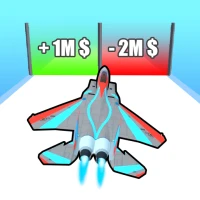






Latest Version
9.6
November 09, 2024
Supersonic Studios LTD
Games
Android
0
Free
com.gc.planeevolution
Report a Problem
More About Plane Evolution!
Unlocking the Secrets of Plane Evolution: A Comprehensive Guide
In the realm of aviation, the evolution of planes has been a fascinating journey marked by innovation, engineering marvels, and a relentless pursuit of efficiency. This article delves into the intricate history and advancements in aircraft design, exploring how planes have transformed over the decades. From the Wright brothers' first flight to the cutting-edge technology of modern jets, we will uncover the key milestones that have shaped the aviation industry.
The Dawn of Aviation: Early Innovations
The story of plane evolution begins in the early 20th century when pioneers like the Wright brothers took to the skies. In 1903, Orville and Wilbur Wright achieved the first powered flight, a mere 120 feet in 12 seconds. This groundbreaking event laid the foundation for future advancements in aviation.
Following the Wright brothers, several inventors and engineers contributed to the development of aircraft. Notable figures include Alberto Santos-Dumont, who made significant strides in aviation in Europe, and Glenn Curtiss, who introduced innovations in engine design and aerodynamics. These early innovators set the stage for the rapid evolution of planes.
The Golden Age of Aviation: 1920s to 1940s
The period between the 1920s and 1940s is often referred to as the Golden Age of Aviation. During this time, commercial aviation began to take off, and aircraft design saw remarkable advancements. The introduction of all-metal aircraft, such as the Douglas DC-3, revolutionized air travel by providing greater durability and passenger comfort.
Additionally, the development of more powerful engines allowed planes to fly longer distances at higher speeds. The Boeing 247, introduced in 1933, was one of the first modern airliners, featuring a streamlined design and advanced safety features. This era also witnessed the rise of iconic aircraft like the Lockheed Constellation and the Boeing B-17 Flying Fortress, which showcased the versatility of planes in both commercial and military applications.
Post-War Innovations: The Jet Age
The end of World War II marked the beginning of the Jet Age, a transformative period in aviation history. The introduction of jet engines revolutionized air travel, allowing planes to fly faster and higher than ever before. The de Havilland Comet, launched in 1949, was the world’s first commercial jet airliner, paving the way for future developments in passenger aviation.
As airlines expanded their fleets, manufacturers like Boeing and Airbus emerged as key players in the industry. The Boeing 707, introduced in the late 1950s, became a symbol of modern air travel, offering unprecedented speed and range. This era also saw the introduction of wide-body aircraft, such as the Boeing 747, which transformed long-haul travel by accommodating more passengers and cargo.
Modern Advancements: Technology and Sustainability
Today, the evolution of planes continues to be driven by technological advancements and a growing emphasis on sustainability. Modern aircraft are equipped with state-of-the-art avionics, advanced materials, and fuel-efficient engines that significantly reduce emissions and operating costs.
Airbus and Boeing are at the forefront of this evolution, with models like the Airbus A350 and Boeing 787 Dreamliner showcasing innovations in aerodynamics and lightweight materials. These aircraft not only enhance fuel efficiency but also improve passenger comfort with quieter cabins and better air quality.
The Future of Aviation: What Lies Ahead?
As we look to the future, the aviation industry is poised for further transformation. Emerging technologies such as electric and hybrid aircraft are gaining traction, promising to reduce the environmental impact of air travel. Companies like Joby Aviation and Archer are developing electric vertical takeoff and landing (eVTOL) aircraft, which could revolutionize urban transportation.
Moreover, advancements in artificial intelligence and automation are set to enhance flight safety and operational efficiency. The integration of AI in air traffic management and predictive maintenance will streamline operations and reduce delays, making air travel more reliable than ever.
Conclusion: A Journey of Innovation
The evolution of planes is a testament to human ingenuity and the relentless pursuit of progress. From the humble beginnings of powered flight to the sophisticated aircraft of today, each milestone has contributed to making air travel safer, faster, and more accessible. As we embrace new technologies and sustainable practices, the future of aviation promises to be as exciting as its storied past.
In summary, the journey of plane evolution is far from over. With ongoing innovations and a commitment to sustainability, the aviation industry is set to soar to new heights, ensuring that the skies remain open for generations to come.
Rate the App
User Reviews















Popular Apps










Editor's Choice