

Latest Version
June 21, 2026
Adam Atamnia
Education
Android
0
Free
com.adam.projectquiz
Report a Problem
More About Learn Python Coding in 21 Days
Unlock the Power of Python: A Comprehensive Guide for Beginners
Are you ready to dive into the world of programming? Python, a versatile and powerful language, is the perfect starting point for beginners. This guide will take you through the essential concepts of Python, ensuring you build a solid foundation. Let’s embark on this exciting journey!
Introduction to Python
Python is renowned for its simplicity and readability, making it an ideal choice for newcomers. In this section, you will learn about:
- Variables: Understand how to store data using variables.
- Indentation: Discover the importance of indentation in Python syntax.
- Comments: Learn how to write comments to make your code more understandable.
Exploring Data Types
Python supports various data types, each serving a unique purpose. Familiarize yourself with:
- Integers (int): Whole numbers without a decimal point.
- Floating-point numbers (float): Numbers with decimal points.
- Strings (str): Text data enclosed in quotes.
- Booleans (bool): True or False values.
- Lists: Ordered collections of items.
- Tuples: Immutable ordered collections.
- Sets: Unordered collections of unique items.
- Dictionaries (dict): Key-value pairs for storing data.
Working with Numbers
Mastering numbers is crucial in programming. In this section, you will:
- Learn how to perform arithmetic operations with integers and floats.
- Explore mathematical functions and their applications.
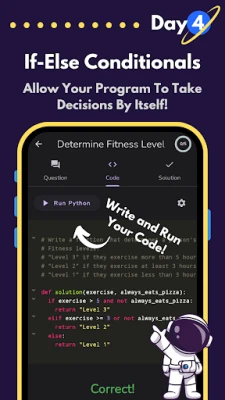
Understanding Conditions
Conditional statements allow your program to make decisions. You will cover:
- If, Else, and Elif: Control the flow of your program based on conditions.
- Boolean Values: Utilize True and False in your logic.
- Comparison Operators: Compare values effectively.
- Logical Operators: Combine multiple conditions.
String Manipulation
Strings are a fundamental data type in Python. You will learn about:
- Concatenation: Join strings together.
- Indexing: Access specific characters in a string.
- Slicing: Extract substrings from a string.
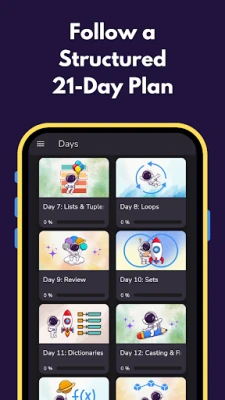
Lists and Tuples
Lists and tuples are essential for data storage. In this section, you will:
- Learn various list operations, including adding and removing items.
- Understand the concept of immutability in tuples.
- Explore common methods for both lists and tuples.
Loops: Iterating Through Data
Loops are vital for executing repetitive tasks. You will discover:
- For Loops: Iterate over a sequence of items.
- While Loops: Repeat actions while a condition is true.
- The range() Function: Generate a sequence of numbers.
Understanding Sets
Sets are unique collections that offer powerful operations. You will learn about:
- Set Properties: Discover the characteristics of sets.
- Union, Intersection, and Difference: Perform set operations to manipulate data.
Dictionaries: Key-Value Pairs
Dictionaries are essential for storing related data. In this section, you will:
- Work with key-value pairs to organize information.
- Explore common dictionary methods for data manipulation.
Functions: Building Reusable Code
Functions are the building blocks of Python programming. You will learn how to:
- Define functions to encapsulate code.
- Use arguments to pass data into functions.
- Return values to get results from functions.
- Utilize lambda functions for concise code.
Modules: Expanding Python's Capabilities
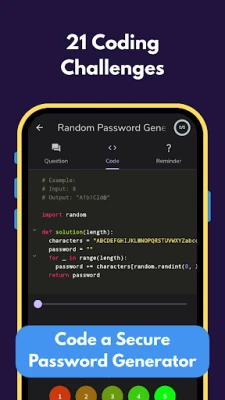
Modules allow you to leverage existing libraries. In this section, you will:
- Import Python libraries such as
mathandrandom. - Utilize functions from these libraries to enhance your programs.
Error Handling: Writing Robust Code
Handling errors is crucial for creating reliable applications. You will learn how to:
- Use
try,except, andfinallyto manage exceptions. - Implement error handling to prevent crashes and improve user experience.
Class Basics: Introduction to Object-Oriented Programming
Object-oriented programming (OOP) is a powerful paradigm in Python. In this final section, you will:
- Learn the fundamentals of classes and objects.
- Understand how to create and use classes to model real-world entities.
Conclusion
Congratulations! You have taken the first steps toward mastering Python. By understanding these fundamental concepts, you are well on your way to becoming a proficient programmer. Keep practicing, and soon you will be able to tackle more complex projects with confidence!
Rate the App
User Reviews









Popular Apps










Editor's Choice