





Latest Version
1.3.1
February 06, 2026
Eductify
Education
Android
0
Free
com.holucent.grammarf
Report a Problem
More About English Grammar Tests
Mastering English Grammar: A Comprehensive Guide to Nouns, Verbs, and More
Understanding the intricacies of English grammar is essential for effective communication. This guide delves into various grammatical components, including nouns, verbs, adjectives, and more, providing you with the tools to enhance your writing and speaking skills. Whether you're a student, a professional, or simply someone looking to improve your English, this article will serve as a valuable resource.
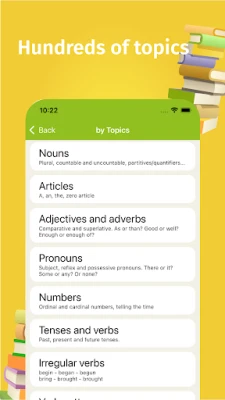
Nouns: Countable, Uncountable, and Partitives
Nouns are the building blocks of sentences. They can be categorized into countable and uncountable nouns. Countable nouns refer to items that can be counted, such as books or apples, while uncountable nouns refer to substances or concepts that cannot be counted, like water or information.
Partitives and quantifiers help specify quantities. For instance, we use phrases like a piece of or some to indicate portions of uncountable nouns. Understanding these distinctions is crucial for accurate communication.
Articles: A, An, The, and Zero Article
Articles play a significant role in English grammar. The indefinite articles a and an are used for non-specific items, while the is a definite article used for specific references. The zero article is used when no article is needed, often with plural or uncountable nouns. Mastering the use of articles can greatly enhance clarity in your writing.
Adjectives and Adverbs: Comparatives and Superlatives
Adjectives and adverbs enrich our language by providing more detail. When comparing items, we use comparative forms (e.g., better, faster) and superlative forms (e.g., best, fastest). It's essential to know when to use as or than in comparisons, as well as the difference between good (an adjective) and well (an adverb).
Additionally, understanding the concept of enough versus enough of can help you express adequacy more precisely.
Pronouns: Subject, Reflexive, and Possessive
Pronouns replace nouns to avoid repetition. Subject pronouns (e.g., I, you) perform the action, while reflexive pronouns (e.g., myself, yourself) refer back to the subject. Possessive pronouns (e.g., mine, yours) indicate ownership. Knowing when to use there or it, and some or any, is vital for effective communication.
Tenses and Verbs: Past, Present, and Future
Verbs are essential for indicating actions and states of being. English has three primary tenses: past, present, and future. Each tense has its own set of rules and forms. For example, the verb begin changes to began in the past and begun in the past participle. Understanding these tenses allows for accurate expression of time in your writing.
Irregular Verbs: A Closer Look
Irregular verbs do not follow standard conjugation patterns, making them unique. For instance, the verb bring changes to brought in both the past tense and past participle. Familiarizing yourself with these verbs is crucial for fluency in English.
Verb Patterns: Infinitives and Gerunds
Some verbs are followed by a to-infinitive (e.g., want to, decide to), while others are followed by a gerund (e.g., enjoying, considering). Knowing these patterns helps in constructing grammatically correct sentences.
Questions, Auxiliary Verbs, and Phrasal Verbs
Formulating questions in English often involves auxiliary verbs. Understanding question tags and indirect questions can enhance your conversational skills. Phrasal verbs, which combine verbs with prepositions, add depth to your language use. For example, give up means to quit, while look after means to care for.
Word Order: Structuring Sentences
English follows a specific word order, typically subject-verb-object. Mastering this structure is essential for clear communication. For example, in the sentence She (subject) reads (verb) books (object), the order is crucial for understanding.
Reported Speech: Indirect Speech and Tense Changes
Reported speech allows you to convey what someone else has said without quoting them directly. This often involves changing the tense of the original statement. For instance, He said, "I am happy" becomes He said that he was happy in reported speech.
Prepositions: Time and Place
Prepositions indicate relationships between words in a sentence, particularly regarding time and place. Common prepositions include at, on, and in. Understanding when to use until or by is also important, as is knowing how verbs interact with prepositions.
Word Formation: Prefixes and Suffixes
Word formation involves creating new words through prefixes and suffixes. For example, the prefix in or im can negate a word (e.g., incomplete), while suffixes like ible or able can indicate capability (e.g., readable). Compound words, formed by combining two words, also enrich the language.
Idiomatic Expressions: Enhancing
Rate the App
User Reviews














Popular Apps










Editor's Choice