
Latest Version
May 02, 2026
jiaxue tool team
Education
Android
0
Free
com.jiaxue.huangdineijing
Report a Problem
More About 皇帝内经
The Huangdi Neijing: The Foundation of Traditional Chinese Medicine
The Huangdi Neijing, also known as the Yellow Emperor's Inner Canon, stands as a monumental text in the realm of traditional Chinese medicine (TCM). This ancient manuscript lays the groundwork for understanding human physiology, pathology, diagnosis, and treatment methods. Revered as the "ancestor of medicine," it has profoundly influenced medical practices in China and beyond.
Overview of the Huangdi Neijing
Comprising 162 chapters, the Huangdi Neijing is divided into two main sections: the Suwen (Basic Questions) and the Ling Shu (Miraculous Pivot). Each section delves into various aspects of health, disease, and the intricate relationship between the human body and the universe.
Key Features of the Huangdi Neijing
Comprehensive Structure
The text's structure allows for a systematic exploration of medical concepts. The Suwen focuses on theoretical foundations, while the Ling Shu emphasizes practical applications, including acupuncture and meridian theory.
Search Functionality
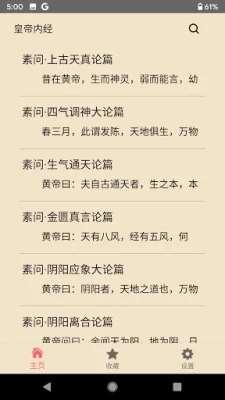
Modern software applications have enhanced accessibility to the Huangdi Neijing. Users can search for specific chapters or content by keywords related to the text, such as "Huangdi Neijing" or "diagnosis methods." This feature facilitates a deeper understanding of the material.
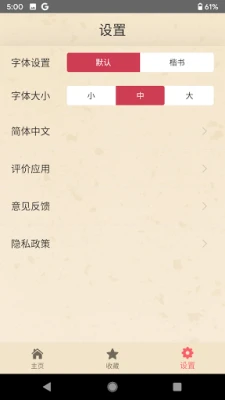
Font Customization
To cater to diverse reading preferences, software tools allow users to display the text in various fonts. This customization enhances readability and ensures that the ancient wisdom of the Huangdi Neijing is accessible to all.
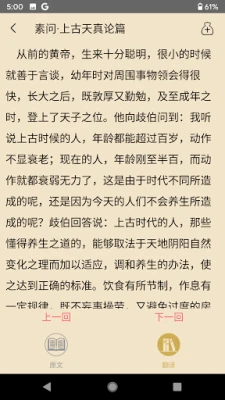
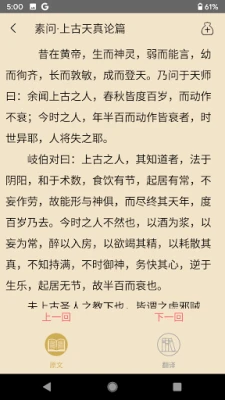
Original Text and Translations
For those interested in both the original Chinese text and its translations, many applications provide side-by-side comparisons. This feature is invaluable for students and practitioners who wish to grasp the nuances of the language and concepts.
Favorites and Bookmarking
Users can bookmark their favorite chapters, making it easier to revisit essential teachings. This functionality is particularly useful for practitioners who wish to reference specific sections during their practice or studies.
Language Support
The Huangdi Neijing is available in both simplified and traditional Chinese, catering to a broader audience. This dual-language support ensures that the text remains relevant and accessible to various demographics.
Adjustable Font Sizes
To accommodate different visual needs, many applications allow users to adjust font sizes. This feature ensures that everyone, regardless of their eyesight, can engage with the text comfortably.
The Impact of the Huangdi Neijing on Modern Medicine
The principles outlined in the Huangdi Neijing continue to resonate in contemporary medical practices. Its holistic approach emphasizes the balance between body, mind, and environment, a concept that is increasingly recognized in modern healthcare.
Integration with Western Medicine
As the world becomes more interconnected, the integration of TCM principles from the Huangdi Neijing with Western medical practices is gaining traction. This fusion allows for a more comprehensive approach to patient care, addressing both physical and emotional well-being.
Educational Resource
The Huangdi Neijing serves as a foundational text in TCM education. Medical students and practitioners study its teachings to gain insights into diagnosis and treatment strategies that have stood the test of time.
Conclusion
The Huangdi Neijing is not merely an ancient text; it is a living document that continues to shape the landscape of medicine today. Its profound insights into human health and disease offer valuable lessons that transcend cultural boundaries. As we embrace the wisdom of the past, the Huangdi Neijing remains a guiding light for future generations of medical practitioners.
Rate the App
User Reviews











Popular Apps










Editor's Choice